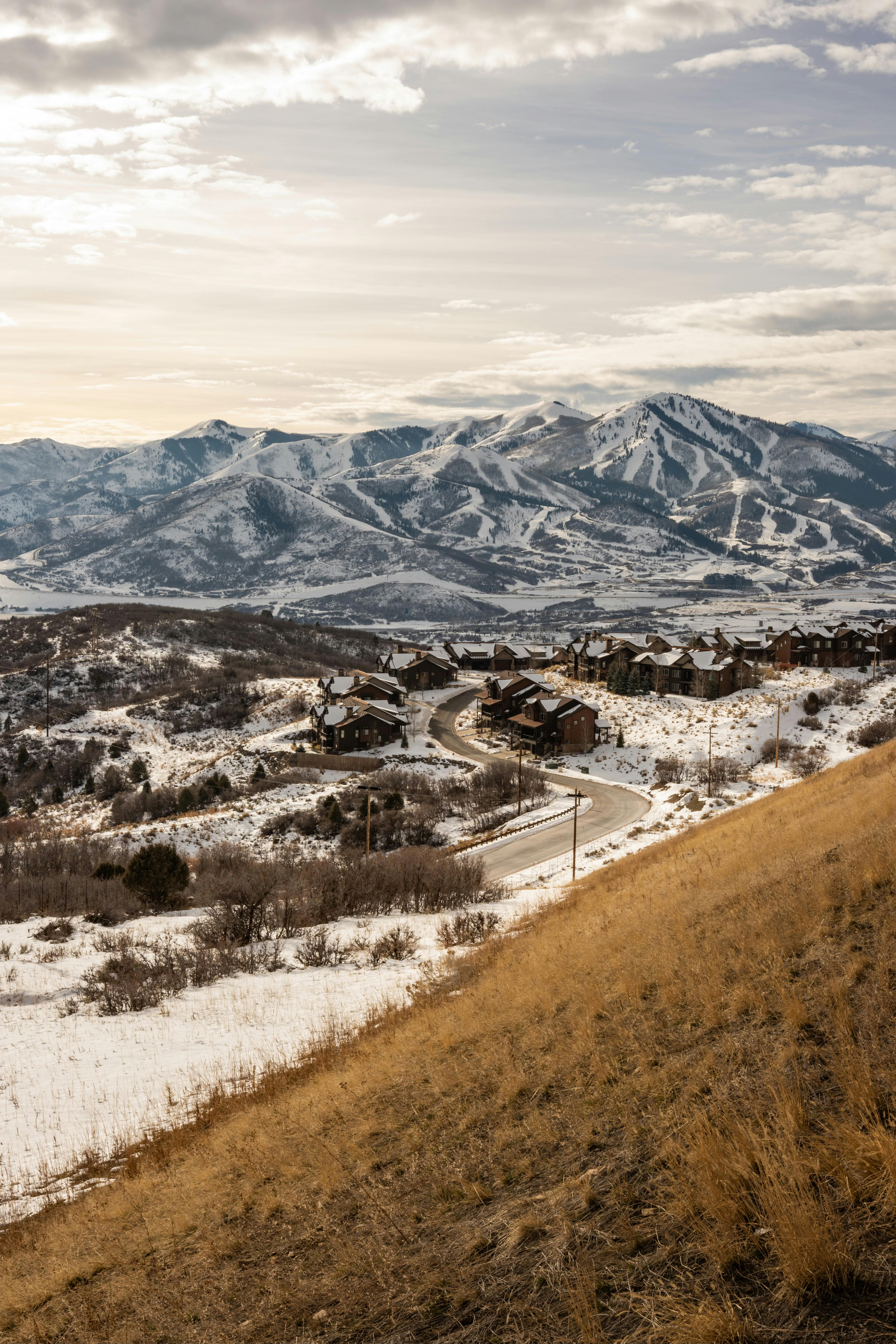
Living in Park City & Heber Valley
Living in Park City, Heber Valley, and Midway — home prices, schools, commutes, and honest mountain-town trade-offs on the Wasatch Back.
Drive east on I-80 through Parley's Canyon and the Salt Lake Valley disappears behind you in about twenty minutes. The freeway crests at Parley's Summit, drops into the high plateaus of Summit and Wasatch counties, and the entire feel of the place shifts. The air is drier. The sky sits closer. The towns are smaller and the open space between them is still, genuinely, open. This is the Wasatch Back — the eastern slope of the range that defines Utah's population corridor — and it operates on a different set of rules than the valley floor below.
At a Glance
- Median Home Price: $3M+ (Park City), $600K–$800K (Heber City), $850K–$1M (Midway)
- Combined Population: ~34,000 across three towns
- School Districts: Park City School District (top 10 in Utah), Wasatch County School District (2025 Best of State)
- Commute to Downtown SLC: 35–45 min from Park City via I-80, 50+ min from Heber via US-189
- Nearest Ski Resorts: Park City Mountain, Deer Valley (5 min from Park City), Soldier Hollow (15 min from Heber)
- Vibe: Mountain-town living on the eastern slope of the Wasatch — world-class skiing, 350+ miles of trails, and a different pace of life 30 minutes from Salt Lake
Why the Wasatch Back?
Park City is the anchor, the name everyone knows. A former silver mining town turned world-class ski destination, it has spent the last four decades layering resort infrastructure on top of a legitimate small-town identity. The result is a place that's simultaneously a global brand and a community of roughly 8,300 permanent residents who still argue about parking on Main Street.
South of Park City, the Heber Valley opens up — a wide agricultural basin ringed by mountains where Heber City has grown from a quiet ranching town into a small city of nearly 19,500. Midway, its neighbor to the west, holds closer to 6,000 people and leans hard into its Swiss-immigrant heritage, hot springs, and a pace of life that makes Heber feel like a metropolis by comparison.
The people who end up here tend to fall into a few categories: outdoor athletes who need daily mountain access, remote workers who traded a valley commute for a view of Timpanogos, ski industry professionals, retirees who sold a house on the Wasatch Front and bought something with acreage, and families who decided the trade-offs of small-town mountain living were worth it. What unites them is a willingness to drive Parley's Canyon or US-189 when the situation demands it and a conviction that the extra effort buys something the valley can't match.
What It's Like to Live in Park City, Heber Valley & Midway
Park City, Heber City, and Midway sit within thirty minutes of each other, but they don't feel like variations on a theme. They feel like different towns in different states.
Park City reads like a mountain town that has been to finishing school. Main Street's historic storefronts house galleries, high-end restaurants, and boutiques alongside a handful of holdover bars that still feel like they belong to miners. The town runs on two economies — tourism and real estate — and both are visible everywhere. During ski season, the population swells dramatically. During Sundance in January, it becomes something else entirely. But step off Main Street into the residential neighborhoods and Park City settles into something quieter: families walking to Ecker Hill Middle School, mountain bikers loading up at trailheads, dogs in every yard. The locals have developed a practiced ability to coexist with the resort economy without being consumed by it.
Heber City is the Wasatch Back's workhorse. It has the grocery stores, the hardware stores, the car dealerships, the school campuses, and the kind of mid-block restaurants where the waitstaff knows half the room. Main Street still has a Western downtown grid feel, though development pressure has pushed new retail and residential out along US-40 in both directions. Heber doesn't have Park City's polish, and most residents consider that a feature. The cost of living is lower, the lots are bigger, and you can buy a family home here without a trust fund or a tech IPO.
Midway is the quiet one. Settled in the 1860s by Swiss and German immigrants, it has held onto a sense of place that feels almost anachronistic. The Homestead Resort and its geothermal crater — the only warm-water scuba destination in the continental U.S. — anchors the west side of town. Swiss Days every August draws thousands. The streets are tree-lined, the lots are generous, and the zoning has kept things from tipping into subdivision sprawl. Midway residents tend to be deliberate about having chosen Midway specifically, not just the Heber Valley generally.
Wasatch Back Schools, Housing Costs & Commute Times
Schools
Park City School District serves Park City and the surrounding Snyderville Basin with approximately 4,050 K-12 students. It's small by Utah standards, and that's largely the point. The district ranks in the top 10 of Utah's 93 districts according to SchoolDigger, earning a 5-out-of-5 star rating. Park City High School ranks fifth in the state per U.S. News. Class sizes stay manageable, facilities are well-funded (resort tax revenue helps), and the sense of community within the schools is strong. The trade-off is limited program breadth — a district this size can't offer the same range of AP courses or extracurricular options as a large Wasatch Front district like Canyons or Alpine.
Wasatch County School District covers Heber City, Midway, and the surrounding valley. It was named Utah's 2025 Best of State educational institution, which raised some eyebrows given its historically middle-of-the-pack reputation. But the numbers back it up: the district jumped from 28th to 1st in Language Arts statewide and from 33rd to 3rd in Math. Wasatch High School serves the entire valley. Old Mill Elementary in Heber and Midway Elementary both score well above state averages, with Midway posting 70% math proficiency against a 40% state average. The district earned recognition in the 2025 Harvard-Stanford Education Recovery Scorecard as the only Utah district showing academic growth in both math and reading since the pandemic.
Commute
Getting to Salt Lake City means going over or around a mountain range. From Park City, I-80 through Parley's Canyon takes 35-45 minutes to downtown SLC in good conditions. In a winter storm, that number can double. UDOT's traction law kicks in regularly — if your tires aren't snow-rated, you're not getting through. High Valley Transit runs a commuter bus (Route 107) between Kimball Junction and Salt Lake Central for those who'd rather not white-knuckle it.
From Heber City, US-189 through Provo Canyon drops you into the south end of Utah Valley in about 30 minutes, with Salt Lake City another 45 minutes north on I-15. The alternative route — US-40 to I-80 — runs about 50 minutes to SLC but puts you in the same Parley's Canyon weather lottery as Park City commuters. Either way, if you're commuting to the Wasatch Front daily, you'll spend real time in a car. Most Wasatch Back residents have either gone remote, work locally, or have made peace with the drive.
For comparison, a commute from Draper to downtown Salt Lake runs 25-35 minutes on I-15 — no canyon, no weather risk, no chain law. That gap matters on a Tuesday in February.
Housing Costs
The price spread across the Wasatch Back is enormous. Here's where things stood as of early 2026:
Park City proper: The median single-family home within city limits has crossed $3 million and continues climbing. Condos and townhomes offer entry points starting around $800K-$1.2M, but anything ski-in/ski-out or within walking distance of Main Street commands a steep premium. The greater Park City area — including Snyderville Basin communities like Jeremy Ranch and Silver Springs — brings the median closer to $1.5-2M.
Heber City: Median home prices sit around $600K-$800K for single-family homes, with newer developments pushing above $900K. Townhomes and condos start in the mid-$400Ks. Compared to Park City, you get roughly twice the house for half the money. That math is driving much of Heber's growth.
Midway: Median prices land between $850K and $1M, reflecting the town's desirability, limited inventory, and larger lot sizes. Midway doesn't have the entry-level options that Heber does — there's very little condo or townhome stock. You're buying a house on land, and the land isn't cheap.
Best Neighborhoods in Park City, Heber City & Midway
Park City
Prospector is the locals' neighborhood. Bordered by the school campus, the Rail Trail, and the Prospector Square commercial area, it's walkable, unpretentious, and close to everything without the Main Street price tag. Older condos here represent some of the last semi-affordable options in town.
Park Meadows is Park City's largest in-town neighborhood — over 1,000 single-family homes and 500-plus townhomes built from the 1970s onward. Proximity to the schools, the Park Meadows Country Club, and the Round Valley trail system makes this the default choice for families who want to be in the middle of things.
Thaynes Canyon predates both Prospector and Park Meadows and commands top dollar. The neighborhood stretches from the flat terrain below Park City Mountain Resort up into the steeper parcels of Iron Mountain. Views of the ski runs from your living room. Prices reflect that.
Jeremy Ranch wraps around a private 18-hole golf course off I-80, north of Kimball Junction. It's popular with full-time residents who want space, sunshine, and a reasonable shot at getting to SLC in 30 minutes. The trade-off is that you're ten minutes from Main Street rather than five.
Silver Springs sits between Canyons Village and Kimball Junction and draws families with its flat topography, connected trail network, and community feel. Single-family homes dominate. If Park Meadows is sold out or over budget, Silver Springs is where most agents will point you next.
Promontory is the luxury play — a private, gated community on the ridge between Park City and the Jordanelle Reservoir with its own Pete Dye golf course, equestrian facilities, and a level of amenity packaging that caters to a second-home crowd. Homes here start well above $2M and climb from there.
Heber City
Development in Heber has pushed north and east along US-40. North Village is a newer mixed-use development on recently annexed land that will add significant housing stock over the coming years. Downtown Heber's Central Neighborhoods District — part of the city's new Central Heber Overlay Zone adopted in 2025 — is seeing infill development including ADUs and smaller-lot homes aimed at keeping some portion of the housing stock accessible. The established neighborhoods south of Main Street between 100 East and 600 East remain the most walkable to downtown and tend to hold their value well. Further out, newer subdivisions like Red Ledges offer resort-style amenities (golf, spa, pools) at prices that would be considered entry-level in Park City.
Midway
Midway's development pattern is more dispersed. The streets around Main Street and Center Street have the most traditional small-town character — older homes, mature trees, walking distance to shops and restaurants. The west side of town near the Homestead Resort draws buyers who want proximity to the hot springs and the Swiss-village aesthetic. Newer development has pushed toward the edges, particularly along River Road and toward the Soldier Hollow area, where homes on larger lots offer views of the Heber Valley floor and direct access to Nordic skiing and trail networks.
Things to Do on the Wasatch Back — Skiing, Trails & Mountain Life
The Wasatch Back's outdoor access is the whole point. Two world-class ski resorts sit within minutes of Park City's core neighborhoods. Park City Mountain — the largest ski resort in the U.S. by acreage — connects Canyons Village and the original Park City base via the Quicksilver Gondola. Deer Valley, directly east of Old Town, has undergone a massive expansion for 2025-26: nearly 100 new runs, 10 new chairlifts, the East Village Express Gondola, and a new base village with hotels, dining, and retail. Deer Valley's total skiable terrain now exceeds 4,300 acres. A Four Seasons hotel is slated to open at the East Village by 2028.
Heber Valley residents are 20-25 minutes from Deer Valley's new east-side access and 15 minutes from Soldier Hollow, which hosted the 2002 Olympic biathlon and cross-country events and remains one of the best Nordic skiing venues in the West.
Summer flips to mountain biking, and Park City is an IMBA Gold-Level ride center — one of a handful in the world. The trail network spans over 350 miles across more than 7,000 acres of preserved open space. Round Valley is the local after-work favorite: 30-plus miles of rolling singletrack through sage and scrub oak, accessible from multiple trailheads. The Historic Union Pacific Rail Trail runs 28 miles from Park City to Echo Reservoir — flat, mellow, and perfect for families or gravel bikes. The Mid-Mountain Trail traverses the resort mountains at around 8,000 feet and is one of the most scenic rides in Utah.
Dining in Park City punches well above its weight for a town of 8,000. High West Distillery on Main Street operates as the world's only ski-in distillery and has become a destination in its own right. Handle draws serious food people for its inventive small plates. Firewood on Main does wood-fired everything across five courses. Off Main Street, Vessel Kitchen in Kimball Junction is where the locals actually eat lunch.
Heber's food scene is simpler but growing. Midway Mercantile and Cafe Galleria serve the Midway crowd, while Heber's Main Street has added enough options in recent years that you no longer need to drive to Park City for a decent meal.
The cultural calendar is anchored by the Sundance Film Festival in January, the Park City Kimball Arts Festival in August, and Midway's Swiss Days, also in August. The Egyptian Theatre on Main Street runs year-round programming. The Heber Valley Railroad offers scenic excursions through Provo Canyon that draw tourists but also provide a genuinely beautiful ride that locals take visitors on at least once.
Wasatch Back Real Estate Market in 2026
The Park City real estate market operates in two distinct tiers. The resort and luxury segment — ski-in/ski-out condos, Deer Valley properties, Promontory estates — is driven by out-of-state buyers, second-home demand, and the Deer Valley expansion, which has injected fresh energy (and fresh capital) into the east side of the market. Median prices within Park City limits have pushed past $3 million, with the broader Snyderville Basin median around $1.5-2M. Inventory remains tight, particularly for anything under $1.5M.
Heber Valley is increasingly positioned as the pressure-relief valve. Families and working professionals who want Wasatch Back access but can't afford (or don't want) Park City prices are driving steady demand. The city's population has nearly doubled in fifteen years, and development approvals along US-40 suggest the growth isn't slowing. Prices have risen sharply since 2020, but the gap between Heber and Park City remains wide enough that the value proposition holds.
Midway's market is constrained by limited inventory and a community that has actively resisted high-density development. Homes trade less frequently here, and when they do, the prices reflect both the scarcity and the lifestyle premium. If you're waiting for a deal in Midway, you'll be waiting a while.
For context, a comparable family home in Cottonwood Heights runs $700K–$900K with a 30-minute ski commute to Brighton or Solitude — no canyon pass required, no resort-town pricing. The Wasatch Back asks you to pay more for the privilege of living at the mountain rather than driving to it.
Is the Wasatch Back a Good Place to Live?
The Wasatch Back delivers a version of mountain living that's hard to find this close to a major metro area. Park City offers world-class skiing, dining, and culture at world-class prices. Heber City provides a more grounded, affordable alternative with strong schools and room to grow — though "affordable" is increasingly relative. Midway is the quiet card for buyers who want space, character, and a pace that hasn't been fully overwritten by growth.
The trade-offs are real. Winter driving through Parley's Canyon or Provo Canyon is not a suggestion — it's a commitment. The cost of living, even in Heber, runs well above the Utah median. The small-town infrastructure means fewer choices for healthcare, shopping, and schools. And in Park City specifically, you'll share your town with millions of visitors who don't always treat it the way you would.
But if the mountains are the reason you're in Utah, and you want to wake up in them rather than look at them from across the valley, the Wasatch Back is where that math works out.